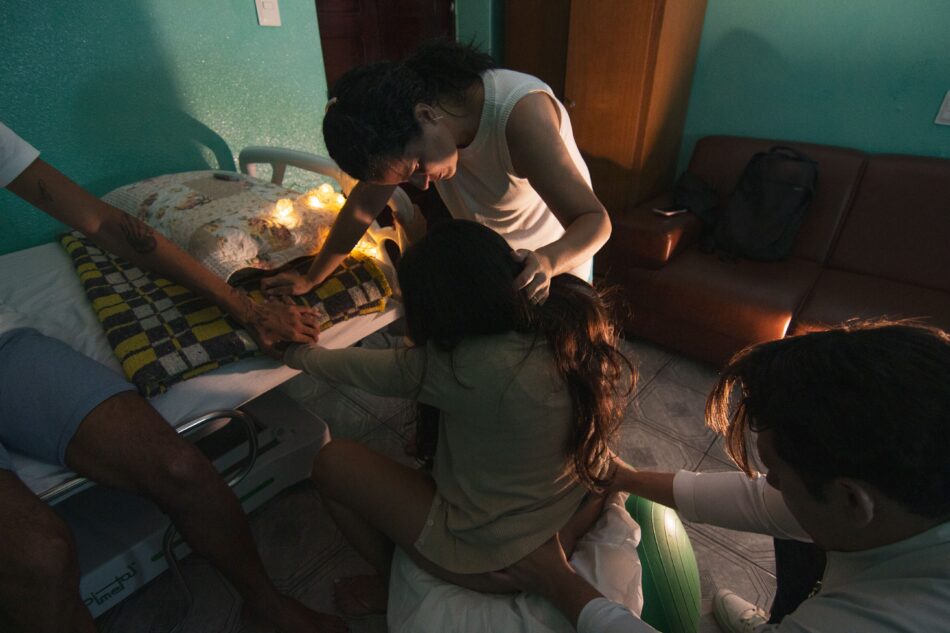
On Mount Desert Island, the maternity ward used to feel like a community gathering. New parents had the space to themselves, where nurses waved down the hallway, midwives talked about yesterday’s sports game, and nearly everyone had visited Hannaford Supermarket and Pharmacy at least once this week.
Rural maternity care in Maine worked because local providers often wore many hats.
“They are the nurses and the midwives in the hospital, but they are also parents on your kids’ baseball team, and you know them from the grocery store,” said Sarah Tewhey, co-director of the Maine Doula Coalition. “So, there’s automatically a lot of trust.”
But that’s all changed over the last decade. The distance to deliver has grown, and many of those same community members can no longer make the trip.
Across the state, there has been a wave of labor and delivery unit closures that have hit rural communities hard, forcing pregnant women to travel further to receive care. These longer drives aren’t just an inconvenience – they’re reshaping how families plan their births and how rural providers respond to emergencies.
“Maine is experiencing one of the most acute declines or closures of birth units,” said Katherine Simmonds, a clinical professor at Northeastern University who leads rural health initiatives.
Eleven birthing units have closed – four of them in 2025 alone, according to The Maine Monitor. The most recent closures stretch more than 150 miles, from Aroostook County to Waldo County, with additional losses in Hancock and Kennebec counties. The earlier losses hit communities in Oxford, York, Washington, and Penobscot counties.
The labor unit closures span communities of different sizes, from Aroostook County, home to about 66,6000 people, to Hancock County, with about 57, 2000 residents and Oxford County, with about 60, 300 (United States Census Bureau). The numbers show that the impact of maternity unit closures can affect areas with very different populations and geography.
The decline in birth rates is another challenge.
There were 11,586 resident births in 2024, compared to 12,001 resident births in 2021- a decline of 415 births (Maine Center for Disease Control and Prevention).
In Lewiston, a larger population center in Androscoggin County, hospitals St. Mary’s Regional Medical Center and Central Maine Medical Center together delivered 1,044 babies in 2021. St. Mary’s announced that it would end maternity services in 2022 due to declining births (News Center Maine).
For Mainers without a birthing unit nearby, the average drive to deliver a baby is 45 minutes, according to an analysis by the Center for Healthcare Quality and Payment Reform. Many of these hospitals that closed their maternity wards were delivering fewer than 100 babies a year, a low birth rate that makes it hard for them to keep the units open.
Simmonds said the closures are a result of many factors.
Maine has the oldest population in the nation, with the highest birth rate being in the 50s. Since then, lower birth rates have left rural hospitals struggling, as they must be ready 24/7 to care for pregnant people or people experiencing pregnancy complications.
A maternity ward also requires fully trained staff – physicians who can perform c-sections, nurses skilled in labor and delivery, and anesthesiologists on hand at all times.
Simmonds added that financial struggles make it even harder.
“Medicaid and Medicare do not pay at the rates that private insurers pay,” said Simmonds. “In rural areas, more people are dependent on that kind of federal state funding for pregnancy and birth care.”
Hospitals take a financial hit when caring for Medicaid patients, Simmonds noted.
The closures are also affecting the people on the front lines of rural maternity care.
With fewer birthing units available, more pregnant women are being induced earlier than medically necessary so providers can plan around long travel times.
For Chief Christopher Moretto of the Winthrop Ambulance Service, the impact is personal.
His daughter-in-law, pregnant with her third child, had to travel an hour to Farmington to deliver, so her doctor scheduled an early induction.
Meanwhile, EMS workers, in some cases, have to assist with deliveries in the field.
Paul Landry, Chief of the Northern Oxford Regional Ambulance Service, said he has delivered four babies, and Med-care crews have delivered two in the past month.
From their base, it’s roughly a 40-minute drive to the nearest hospital with a maternity unit, and Landry noted that some parts of their coverage area are as far as an hour and 20 minutes away.
Midwives and doulas are also stepping into the gap, traveling greater distances to support their clients. Midwives provide clinical care during pregnancy, delivery, and the postpartum period. Doulas, on the other hand, are nonmedical professionals who provide physical, emotional and educational support before, during and after childbirth. While their roles are different, both can be a part of a pregnant woman’s team.
“The actual care we are providing hasn’t changed a lot, but we are traveling further to get to people’s hospitals with them,” said Tewey.
Tewey lives on Mount Desert Island, where the hospital’s OB unit closed on July 1st. Even before the closure, the unit handled only 50 to 100 births a year, but she said everyone on the floor was familiar with each other.
Now, families must travel outside their community – anywhere from 30 minutes to several hours – to deliver.
Anna McGuire, co-chair of the Maine chapter of the National Association of Certified Professional Midwives practicing in the Bar Harbor area, said it can take one or two hours to reach the nearest hospital.
She said that families who were once undecided about home birth are now feeling pushed toward it because of the long travel distances.
“As a midwife, it’s a safety concern if we’re planning a home birth, and we’re an hour from the hospital; if we have an emergency, that’s a significant thing to consider,” said McGuire.
Because of that, some families head to the hospital earlier than necessary, she added. Others may begin the trip in a private car instead of waiting for an emergency vehicle that isn’t staffed.
Natalia Hall, an Associate Vice President for the women’s health service line at Northern Light Health, said some families face travel times of up to two hours to reach a hospital.
So, because of those long distances, many are choosing to stay closer to delivery centers as their due dates approach. Other patients are skipping certain prenatal visits altogether because of the time and cost of the drive.
For families accustomed to knowing the nurses, midwives and doulas caring for them, traveling further can mean more than leaving home. It can also mean a new experience where they leave behind the familiarity of a local care team.
In response, Northern Light Health is exploring new ways to close those gaps – including the possibility of mobile units and standalone birth centers. The system is also looking to partner with other healthcare organizations, doulas, and midwives across the state to cover as much geography as possible.
“We can’t look at this individually anymore,” said Hall.
The state has begun investing in new support systems aimed at exactly that.
The Transforming Maternal Health Model, or TmaH grant, awarded funding to several states, including Maine, to improve maternal health access in rural regions, according to Centers for Medicare and Medicaid Services. Maine is one of the 15 states participating in the 10-year program designed to expand access to maternal care and strengthen connections among hospitals, providers and community-based organizations, according to Maine’s Department of Health and Human Services. Each state Medicaid agency is eligible for up to $17 million in cooperative agreement funding over the 10-year period, with the award varying based on the state’s needs.
Tewey, Hall, and McGuire all emphasized how crucial this funding will be.
Still, Hall believes the solution is changing the payment model.
“[Hospitals should be] paid whether or not a patient comes in,” said Hall. “That’s how our labor and delivery units will stay open.”
In rural Maine, keeping a maternity unit open means more having a hospital room available. It means keeping care that’s familiar close enough to reach, staffed enough to respond and funded enough to remain part of the close-knit community.
