
Like most 60-year-olds, Chris Moretto decided it was time to retire. After 45 years of fire and emergency medical services work, mostly in rural Maine, he was beginning to feel the wear and tear of the job. Arthritis and injuries suffered throughout his career caught up to him.
However, when a position with Winthrop Ambulance Service opened at the beginning of 2025, Moretto realized he was not quite ready to leave public safety. By May, Moretto was appointed the new EMS chief in Winthrop, Maine, a town with a population of 6,121.
Moretto is now learning the administrative side of the profession. Yet, one of the biggest challenges he faces is an EMS workforce shortage. According to a 2024 study by the American Ambulance Association, the overall turnover rate amongst paramedics and EMTs annually ranges between 20 and 30 percent.
“So, say we have a bad crash, forbid a school bus crash, it’s going to be harder to get people that work just Winthrop to come here,” Moretto said. “So now we’re going to have to rely more on mutual aid, Augusta, Gardner, Turner, and other towns from a lot further away.”
In Maine, the deficit reaches new heights as ambulance services are heavily relied on in a rural healthcare system strained by several issues. The state faces a lack of healthcare funding, hospital closures, and waning healthcare services.
These issues, combined with the state’s unique rural landscape and rapidly aging population, force Maine’s EMS personnel to pick up the slack with staff that they do not have.
Low wages are some of the biggest factors driving the EMS shortage. Lack of funding can often lead to lower wages for EMS providers, especially those in rural communities. Volunteer staff are common in these areas to help, but are declining due to the high training costs. Full-time paid positions are often limited at each EMS agency. They can usually only be increased if more funding is approved by town councils in their service areas. A new ambulance can cost in the $300,000-$400,000 range. In Winthrop, the town council also recently purchased a $70,000 stretcher system.
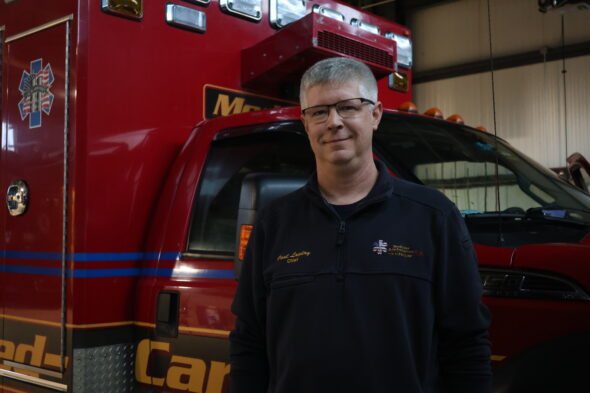
Photo by Leah Clark, Paramedic Chief Paul Landry Jr.
Depending on whether they are full-time or part-time staff, some personnel will make long commutes to work at multiple agencies to earn a comfortable living wage. It is very common for EMS providers to work at multiple agencies, according to Paul Landry Jr., director and chief of operations for Med-Care Ambulance Service. Some can work up to four at once, leading to burnout and a lack of work-life balance, which are other factors driving the shortage.
EMS personnel often work in 12-hour and 24-hour shifts. Many EMS agencies implement policies to prevent their staff from exhaustion, including capping the number of hours they can work in a week. However, these policies only extend to individual agencies.
“There’s not enough providers in the state to staff the number of positions that need to be filled,” Landry said. “So we’re really depending on our EMS providers to work an average of 68 and 60 to 80 hours a week, or this system will not continue.”
Located in Mexico, Maine, with a population of 2,756, Med-Care Ambulance Services has been able to soften the impact of EMS shortages. Landry, who has been director and chief since 2021, implemented mental health resources and peer-support programs after realizing how big an issue mental health was becoming amongst EMS personnel.
“We’ve become involved with a debriefing group so that when we do have these traumatic kinds of calls, we have somebody to call, coming in and help our people,” he said. “Over the past four years, we’ve lost more staff to mental health issues than we have to any other cause.”
‘Entry door to healthcare’ in rural Maine
Maine’s dependence on its EMS system is partially caused by another shortage: primary care physicians. In its fully rural counties, there are 983 residents per primary care physician. With many of Maine’s current physicians reaching retirement age, not enough new ones are entering the workforce to replace them.
“It’s a double whammy. As the community ages, the population needs more healthcare. That’s just a truism in healthcare: the older you get, the more you need,” said Jeffrey Austin, the Maine Hospital Association’s Vice President of Government Affairs & Communications. “At the same time, that same community is retiring from work.”
The process of finding a new primary care physician can be an exhausting one, causing many Maine residents in rural areas to stop receiving that care. Combined with higher rates of chronic illnesses, residents become sicker before calling for EMS, where they are high-risk patients.
Moretto has seen an increase in calls throughout his career and knows the impact of the primary care physician shortage on it. Moretto’s former primary care physician recently closed down, leaving him to find a new one.
Maine created community paramedicine programs in 2012 to bridge this gap, allowing specially trained paramedics to provide in-home care and assessments in collaboration with their usual medical provider. The program began with 12 agencies before becoming permanent in 2017. There are now 21 participating agencies, including Winthrop Ambulance Service and Med-Care Ambulance Services. The programs being developed on a community-needs basis allow them to see their patients as their neighbors, according to Moretto.
“Small communities, you know, it’s going to be the service coming from a certain town. For a lot of these people here that work here, they grew up here, so the people that they’re going to help, they’ve known their whole lives,” Moretto said. “So, as a patient, a lot of times you’re seeing a familiar face coming into your house, and that in itself kind of helps calm down the situation.”
However, community paramedicine programs are under threat of being cut as the federal government rolls back Covid-19 era grants. In March, ten EMS agencies learned $1 million in federal grants previously awarded to them were cut. Maine is expected to lose $5 million in Medicaid funding in 2027.
Landry said it has been a struggle to find alternative funding for when their grants have run out.
A solution might already be in the works through Congress. Maine is seeking $500 million in its application to the Rural Health Transformation (RHT) Program. The RTH Program is a new national initiative with $50 billion to strengthen rural healthcare systems in all 50 states over the next five years.
The fund stems from the Trump Administration’s “One Big Beautiful Bill,” which passed in July. The RTH Program was created to offset cuts Maine will face from the bill. Funds will be distributed in 2026.
According to Austin, funding from the RTH Program should benefit several aspects of Maine’s healthcare, not just EMS agencies. Hospitals would receive crucial funding in a time when five of the state’s rural hospitals are at immediate risk of closing. Two in five birthing centers and one in four nursing homes have closed in the state since 2015.
These closures have forced Maine’s EMS to step up in distance as well. As of December, Maine will only have two hospital trauma centers. If these trauma centers are at capacity, EMS providers often have to drive two or more hours to a trauma center in Boston, Mass.
Maine’s extreme winters and mountainous landscape already cause most rural EMS providers to travel long distances to reach the outer parts of their service areas. The long distances can also cause more maintenance of ambulances or the purchase of a new one.
“In the rural communities, we’re kind of the entry door to healthcare,” Landry said. “There is a lot of people that depend on us, especially the aging population, particularly in the winter, when it’s even more difficult for them to get out of their house.”
The next generation of Maine’s EMS
As local, state, and federal leadership seek solutions, a more straightforward approach might be the answer.
Across the nation, EMS agencies are tailoring their recruiting to Generation Z, who are the largest cohort entering EMS classrooms today. At the 2025 American Ambulance Association Annual Conference, EMS administrators learned other ways to recruit Gen Z outside of higher wages. They were encouraged by experts to spotlight the mission and values-driven aspect of the profession.
In Winthrop, Moretto hopes to generate an interest in EMS work among young people by collaborating with local high schools. Winthrop Ambulance Service will be participating in upcoming career days. Moretto also plans to create a junior EMS program for local teenagers.
“So [we] try to recruit the young kids, get them interested, and to also just get out there in the communities and educate the communities,” he said. “If we can get one or two kids that think, ‘hey, I’m interested in that,’ then we succeeded.”
The program will be similar to junior firefighting programs, one of which Moretto joined at age 15. He believes the program could produce EMS providers who build long careers within their communities. Moretto hopes to one day retire knowing a new generation of EMS has fallen in love with public safety the way he did 45 years ago.
